
A customer calls your warehouse and asks a straightforward question:
“How many cartons of mine do you still have?”
Your team checks the spreadsheet. Someone else checks the dispatch messages. Another person asks the cold-room supervisor.
The question is simple. Getting a reliable answer should be simple too.
For businesses storing stock on behalf of different customers, inventory control is not just about knowing how many cartons are inside the building. It is about knowing whose stock it is, where it is stored, what has moved and whether the records are up to date.
Stock quantity is not the same as stock ownership
A stock list might show that a cold room contains 2,000 cartons of fruit. But that figure alone may not help someone answer a particular customer's enquiry.
Those cartons might belong to several importers. They might be distributed across different cold rooms. Some may be awaiting dispatch, while others have already been released but the inventory record has not been updated.
A dependable warehouse record distinguishes five things:
- Stock owner: Which company owns the goods?
- Product and packing: What is being stored, and in which unit of measurement?
- Location: Which cold room or facility holds it?
- Movement: What quantities were received, released or transferred?
- Exceptions: Are there damaged goods, pending adjustments or discrepancies to review?
Without those distinctions, an apparently accurate total can still produce the wrong answer for one customer.
A simple example: 1,000 cartons received, 300 dispatched
Consider a hypothetical shipment of grapes delivered to Cold Room A.
| Stock movement | Cartons |
|---|---|
| Received into Cold Room A | 1,000 |
| Dispatched to customer | −300 |
| Remaining balance | 700 |
The arithmetic is straightforward. The problem appears when the dispatch has happened physically but the stock record still shows 1,000 cartons. The next employee who checks that record may give an outdated balance.
R2U uses this 1,000-carton scenario in its Warehouse Control Tower demonstration. It is an illustration, not an actual customer transaction or an automatic message integration.
A stock balance is only as reliable as the movements recorded against it. Software may make movement records easier to trace, but it cannot account for a physical dispatch that nobody records.
What a dependable stock workflow looks like
A practical process connects receiving, storage, dispatch and reconciliation.
At receiving
Staff verify what arrived against the available shipment information. Carton quantities, packing specifications, ownership and the destination cold room should be checked before the receipt becomes a reliable stock record.
During storage
The team should be able to find goods by owner and facility, rather than relying on one combined inventory number.
At dispatch
Released quantities should be recorded against the relevant stock position. Retain the movement history so another person can understand how the balance was calculated.
During reconciliation
Investigate discrepancies rather than silently overwriting a number. A physical count, a customer instruction and the system record may disagree. Understanding why matters as much as correcting the balance.
For a warehouse serving multiple businesses, access permissions also matter. Customer-facing records should be limited to the information each customer is authorised to view.
Why visibility matters across several cold rooms
Stock control becomes more complicated when an importer uses multiple facilities or a cold-room operator manages goods belonging to different businesses.
A customer might ask for its total position across locations. An operations manager may need to confirm which facility holds a consignment before arranging dispatch.
Stock records can also support the review of storage and handling charges, but inventory quantities and financial records are not interchangeable. Provider costs, customer billing and margins need supporting commercial records and checks of their own.
The value of better control is the ability to answer these questions without rebuilding every answer from messages and spreadsheets.
How R2U approaches warehouse stock visibility
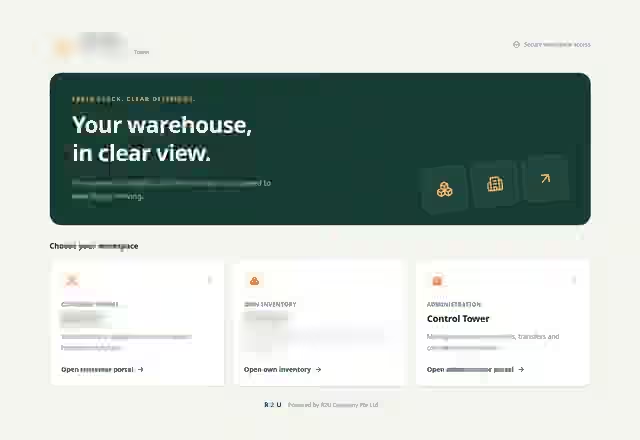
R2U Warehouse Control Tower is designed around wholesale and cold-room operations. The published historical pilot screens show inventory grouped by customer and cold room. Third-party identities and sensitive commercial details in those screens are obscured.
R2U currently describes two proposed early-access levels of functionality:
- Warehouse Core: Container receiving, stock positions, dispatch movements and operational records for a single cold-room workflow.
- Warehouse Operations: Proposed extended support for multiple cold rooms, customer-held stock, provider costs, customer charges and commercial reporting.
Final access, user entitlements and separation of different companies' data must be confirmed during onboarding. The website does not provide instant self-service account activation.
R2U supplies warehouse-management software, not physical cold-room storage.
What to check before choosing warehouse software
Ask your team to demonstrate a complete process using a representative shipment. Verify the received quantity. Record a partial dispatch. Check the remaining balance by customer and location.
Then introduce an exception. What happens when a physical count differs from a record? Can staff find the movement responsible? Finally, examine what a customer can see and who can change a record.
A convincing dashboard helps, but a traceable operational record matters more.
Frequently asked questions
Can a spreadsheet still work for a small warehouse?
Yes. A well-maintained spreadsheet can work when stock volume, users and movements are manageable. It becomes harder when several people update records, multiple customers share facilities or movements arrive through different channels.
Is customer-owned stock the same as the warehouse operator's stock?
No. Goods held for customers should remain distinguishable from goods owned by the operator or other businesses. Ownership and location answer different questions.
Does warehouse software guarantee accurate inventory?
No. Records must reflect actual physical movements. Human checks and periodic reconciliation remain necessary.
Does R2U provide cold-room storage?
No. R2U Warehouse Control Tower is management software. Physical storage services are separate.
THE WORKFLOW IN PRACTICE
Warehouse Control Tower
The next step is to explore the relevant product and ask how it fits your own operation. Demos and any early-access conditions are confirmed separately.
Explore Warehouse Control Tower